Places to visit in Bumthang
Four high valleys of ancient temples, the spiritual heartland of Bhutan.
9 places in this guide
About Bumthang
Bumthang is made up of four valleys, Chokhor, Tang, Ura and Chumey, and is often described as the spiritual heartland of Bhutan. Some of the country’s oldest temples stand here, many linked to Guru Rinpoche and to the treasure revealer Pema Lingpa.
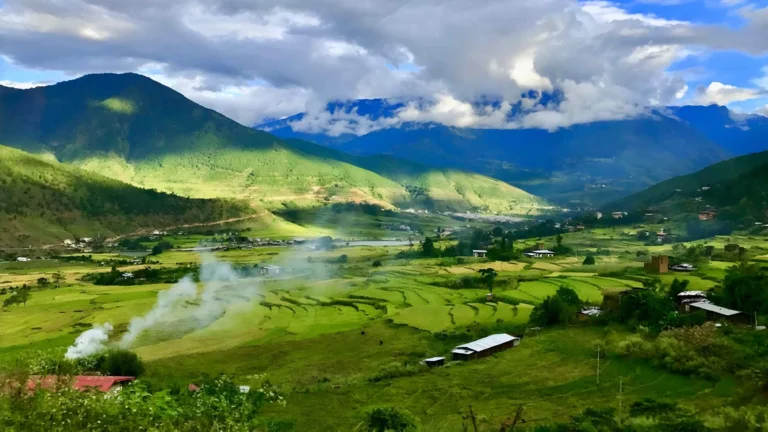
It is cooler and higher than the west, with buckwheat fields, pine forest and small villages. Allow at least two nights.
- RegionCentral Bhutan
- Known forAncient temples, Pema Lingpa, Jambay Lhakhang Drup
- Combine withTrongsa, Mongar
Temples and sacred sites
Jakar Dzong (Castle of the White Bird)
Jakar Dzong stands on a ridge above the Chokhor Valley and the town of Jakar, the main settlement of Bumthang. Its name is usually translated as “castle of the white bird”: according to legend, a white bird settled on the ridge while a site for a monastery was being chosen, and this was taken as an auspicious sign. The present dzong dates from the 17th century.
Today Jakar Dzong houses the administrative offices of Bumthang district and a monastic community. Its long outer walls and tall central tower are impressive, and the views over the wide valley, the town and the surrounding fields of buckwheat and potatoes are among the best in Bumthang. The Jakar Tshechu is held here each autumn. A short walk up from the town leads to the entrance.
Jambay Lhakhang
Jambay Lhakhang, a short distance from Jakar, is one of the oldest temples in Bhutan. Tradition dates it to the 7th century and attributes it to the Tibetan king Songtsen Gampo, as one of 108 temples built in a single day to subdue a demoness lying across the Himalaya; Jambay is said to pin down her left knee, while Kyichu in Paro holds her left foot.
The temple is dedicated to Jampa, the future Buddha Maitreya, whose statue stands in the main shrine. Guru Rinpoche is believed to have visited it, and later kings added chapels. Each autumn Jambay Lhakhang hosts the Jambay Lhakhang Drup, famous for its night-time fire ceremony, in which people pass beneath a burning arch for blessings. Visitors can see the ancient chapels and the courtyard with your guide.
Kurjey Lhakhang
Kurjey Lhakhang stands further up the Chokhor Valley and is one of the most sacred places in Bhutan. Its name means “body print”: according to tradition, Guru Rinpoche meditated in a cave here in the 8th century to restore the life force of a local king, and left the imprint of his body in the rock, which is preserved inside the oldest of the three temples.
The complex consists of three temples from different periods, the third built in the 1990s under the patronage of the Queen Mother, all enclosed by a wall topped with 108 chortens. A large cypress tree beside the temples is said to have grown from Guru Rinpoche’s walking stick. The remains of the first three kings of Bhutan are kept here, and the Kurjey Tshechu is held in summer.
Tamshing Lhakhang
Tamshing Lhakhang stands on the east bank of the Chamkhar Chhu, opposite Kurjey. It was founded in 1501 by Pema Lingpa, the most famous of Bhutan’s treasure revealers, and is one of the most important Nyingma temples in the country.
Tamshing is known for its ancient murals, among the oldest in Bhutan, which were painted under Pema Lingpa’s direction, and for a coat of chain mail said to have been made by him. Pilgrims carry the heavy coat around the inner sanctum three times as an act of devotion. The temple still houses a monastic community, and it is a quiet, atmospheric place with a strong sense of history. It is usually visited together with Kurjey Lhakhang, which is reached by a footbridge across the river.
Mebar Tsho (Burning Lake)
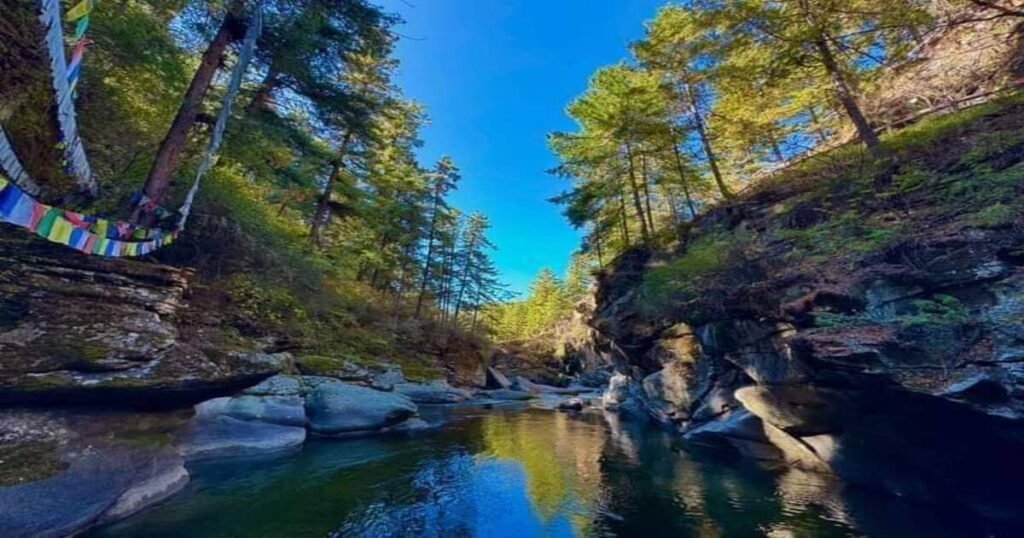
Mebar Tsho, the Burning Lake, is not a lake but a deep pool in a narrow gorge of the Tang Chhu, on the road towards the Tang Valley. It is one of the most sacred sites in Bumthang, closely linked with Pema Lingpa.
According to tradition, Pema Lingpa had a vision that sacred treasures hidden by Guru Rinpoche lay at the bottom of the pool. When local people doubted him, he dived in holding a lit butter lamp and emerged with the treasures in his hands and the lamp still burning, which gave the site its name. Today pilgrims leave offerings and prayer flags around the pool, and the dark water and steep rocks create a powerful atmosphere. A short walk from the road leads down to the gorge.
Walks and village life
Chokhor Valley temple walk
The Chokhor Valley is the heart of Bumthang’s religious life, and a gentle day walk links several of its most important temples. The original website describes a moderate walk through pine forest, fields and villages, visiting Jambay Lhakhang, Kurjey Lhakhang and Tamshing Lhakhang.
Walking between the temples rather than driving allows time to enjoy the open valley, with its fields of buckwheat and barley, grazing cattle and traditional farmhouses. A footbridge across the Chamkhar Chhu links Kurjey with Tamshing on the opposite bank. Along the way your guide can explain the stories of Guru Rinpoche and Pema Lingpa that connect these sites. The walk is suitable for most visitors and can be shortened or extended, and it is especially beautiful in autumn when the fields turn gold.
Tang Valley
The Tang Valley is the most remote of Bumthang’s four valleys, reached by a road that passes Mebar Tsho and climbs gently past farms and villages. Its people traditionally raise sheep and grow buckwheat and potatoes, and the valley is quieter and less visited than Chokhor.
The original website describes moderate walks here visiting traditional villages and temples, with fine mountain scenery. A notable site is Ogyen Choling, a historic manor house that now serves as a museum of rural and religious life, giving an insight into the lives of Bumthang’s noble families. Visiting the Tang Valley adds a day of village life and open landscape to a Bumthang itinerary. Ask us about combining it with a farmhouse stay or a longer walk.
Farmhouse stays
Bumthang is one of the best places in Bhutan to experience life in a traditional farmhouse. Many families welcome visitors for a meal or an overnight stay in their homes, which are built of stone, rammed earth and timber, often with a family shrine room on the upper floor.
The original website mentions opportunities to join in rural activities such as butter churning and the making of ara, the local spirit distilled from grain. Meals typically feature Bumthang specialities such as buckwheat noodles and pancakes, alongside rice and chilli dishes. A traditional hot stone bath, in which river stones heated in a fire are lowered into a wooden tub of water, is often offered. Facilities are simple but comfortable, and a farmhouse evening is often a highlight of the journey.
Fishing in Bumthang
Bumthang’s rivers, including the Chamkhar Chhu which flows through the Chokhor Valley, are known for brown trout. The cold, clear water and the open valley scenery make for peaceful fishing, and the original website notes that local guides can provide equipment and expertise for both novice and experienced anglers.
As everywhere in Bhutan, fishing requires a permit arranged in advance, and it is not allowed on religious days or in certain protected stretches. Catch-and-release is encouraged, in keeping with Buddhist respect for life. Fishing combines well with a longer stay in Bumthang, perhaps as a relaxed half day between temple visits. Let us know when you enquire if you would like to include it, so that we can arrange the permit and an experienced local guide.
Tours that visit Bumthang
Bhutan Heartland Journey
10 days. West to Bumthang, returning by domestic flight.
The Dragon Kingdom's Complete Journey
12 days. Across the country to Trashigang in the east.
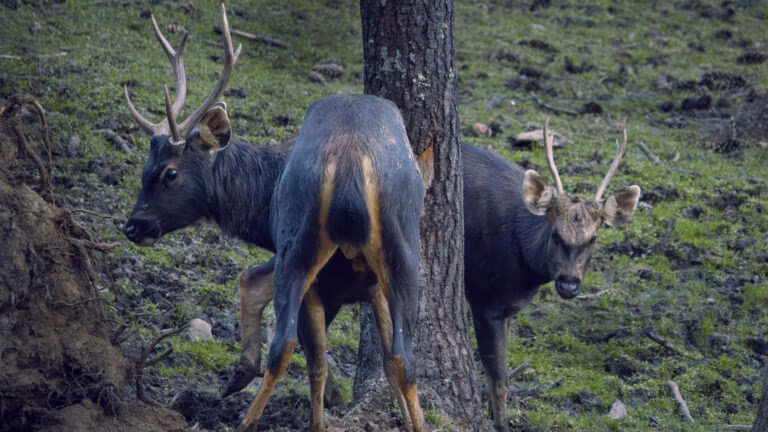
Bhutan Nature and Wildlife Tour
Phobjikha, Bumthang and Royal Manas National Park.
Festivals in Bumthang
The Jambay Lhakhang Drup is held each autumn at Jambay Lhakhang and is known for its night-time fire ceremony.
More in Central Bhutan
Tell us how you would like to travel
Share your dates, interests and preferred pace. We reply personally with ideas for your route and a clear quote.
Prefer to chat? WhatsApp +975 77888822